Special education doctoral students accepted into AAC research fellowship
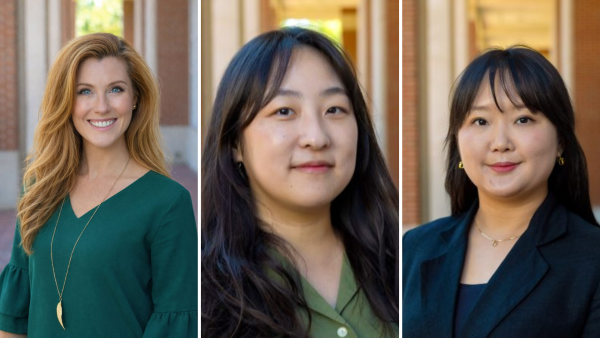
Three UNC Charlotte doctoral students were accepted as fellows for the Rehabilitation Engineering Research Center online seminar on augmentative and alternative communication. The seminar kicks off this fall with a total of 16 virtual meetings carrying over into spring of next year.
The competitive program accepted only 24 fellows out of its pool of candidates across the nation. Fellows Erika Kramer, Yeonhee Lee and Baigalmaa Shura are all within the same cohort pursuing their degrees in Cato College’s special education doctoral program.
Augmentative and alternative communication, also known as AAC, is used by people who, some or all of the time, cannot rely on their speech. AAC comes in many forms including gestures, communication books or high-tech speech generating devices. The seminar fellows includes researchers who use speech as well as researchers who use AAC, while associates are people who use AAC with an interest in participating in inclusive research and teaching.
“They have a really cool mission to support technological innovation and help individuals with complex communication needs to achieve a basic human right: communication,” said Kramer.
Kramer is a second year doctoral student and has been a speech language pathologist by trade since 2009. Her research interests focus on access to AAC for students with complex communication needs.
“I’m really excited to make some connections and hopefully build a professional and congenial network of people to research with,” said Kramer. “Because we care so much about students with disabilities at UNC Charlotte.”
AAC devices can be used to help a variety of individuals with communication difficulties, including individuals diagnosed with autism. Shura’s research focuses on children with autism and their families.
“Many children with autism like to use devices, but my interest is how to convert those interests into AAC, into more knowledge-based AAC rather than just playing games on their devices,” said Shura.
The seminar focuses heavily on including AAC users within their research, emphasizing the importance of gaining the perspective on how to improve these devices from the people using them in their daily lives.
This was one of the motivations for Lee, as the seminar aligns with her interest in learning about how inclusive AAC research is designed in practice. Lee’s research interests focus on early intervention, parent-implemented intervention, and naturalistic behavioral intervention for young children and their families.
“There are so many AAC users getting involved in the research already, and I really wanted to see how they are interacting with each other and how researchers can collaborate with AAC users and families,” said Lee.
Lee and Shura’s experiences in AAC and interest in researching both stemmed from their experiences with their own children. Lee’s interest was sparked after witnessing the help her daughter received while navigating kindergarten through the COVID-19 pandemic.
“That’s kind of the moment you’re like, I can do something as a caregiver,” said Lee.
Shura found interest in AAC from her research, which helped her realize the many different examples of AAC she was already familiar with using with her son who has autism.
“I learned that pictures are a type of AAC. AAC isn’t all about electronic devices. It can be anything you could use for communication,” said Shura.
Those different motivations for starting their research can overlap when students have shared research goals and interests.
“We are really hoping to contribute to the field as a cohort and as individual researchers,” said Lee. The second year doctoral students are a part of the biggest cohort, totalling ten members, and it’s clear each has strongly connected with mentor faculty around their research interests.
“I’ve been so overwhelmingly supported in this program. I would not go anywhere else,” said Kramer, “ The faculty in our program and the research they produce here aligns so closely with things I deeply care about.”
Despite their various motivations for their interest in AAC, each student shared a similar sentiment about the university and its impact on their research and experience. As well as how they are able to collaborate with one another on projects of shared interests.
“We can bring in our different perspectives because our cultural backgrounds are different and our personal experiences are different: as parents, as family, as a caregiver or any number of ways you might encounter someone who has a disability,” said Lee.
The first 8 sessions of the seminar take place this fall with the second round continuing in January through April of 2027. This fall students will have the opportunity to listen, learn and grow their experiences in AAC research and then act upon those experiences with seminar associates in the spring.
Those interested in learning more about AAC can participate in AAC Day with UNC Charlotte’s Student Council of Exceptional Children. The event will take place on October 15 from 11 a.m. to 4 p.m. in the Mebane Hall atrium.
By Meaira Alston