Faculty Spotlight: Kristin Davin’s Project TORCH helps future teachers to regain their identities through language and community
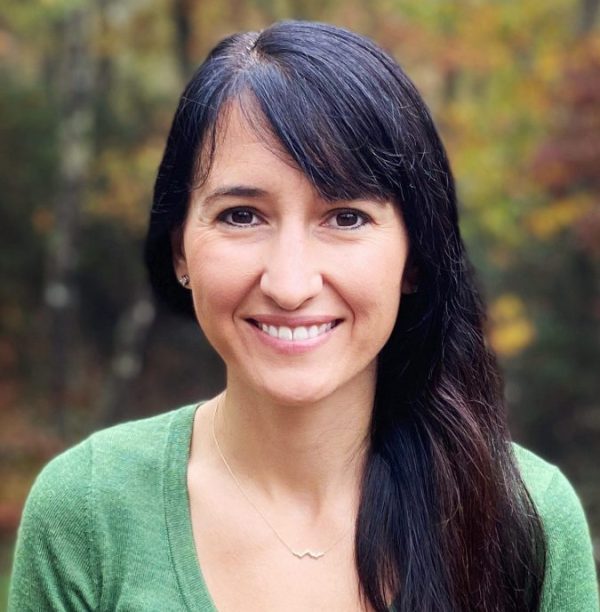
It’s a classic domino effect — one small change cascades over the years to create an enormous impact.
For program director Kristin Davin, changing the delivery of the foreign language education programs from in-person to online necessitated some changes that would tip the first domino. In 2019, the program went online and decided to no longer require language courses, but rather require students to enter the program already proficient in the language they desired to teach.
Davin noticed immediately that this could be a huge net benefit not to just to the program, but North Carolina education at large. Instead of only being able to support students seeking licensure in languages taught at UNC Charlotte, she could now admit students into the program that sought licensure in any language supported by the state of North Carolina, at least doubling the list of language licensures offered. Many of these languages did not have in-state licensure programs at the time that would offer them, as Charlotte was an early adopter of this proficiency-first model.
This presented a unique opportunity: how could UNC Charlotte encourage students to build expertise in these less commonly taught languages, such that they could fill gaps in the education landscape that are often quite hard to fill? What gaps might not even be immediately apparent, but could be served by a student studying another language seeking to become a teacher?
UNCOVERING A NEED
Enter Hartwell Francis, the curriculum developer for the Kituwah Preservation and Education Program, an honorary member of the Eastern Band of Cherokee Indians with a doctorate in linguistics. He saw that Charlotte was now offering Cherokee language education licensure, and as an integral part of the community keeping the Cherokee language alive, he wanted to see what the program was teaching.
He enrolled in the program, and Davin immediately took an interest, connecting with him and his EBCI colleagues to research how the program could meet their needs for Cherokee language teachers and where it was falling short. “We learned a lot about how teaching Cherokee language is different from teaching commonly taught European languages,” said Davin.
Davin and colleagues also learned that the EBCI has a language master-apprentice program, where Cherokee adults are paid a full-time wage for two years to learn Cherokee, with the goal of those participants subsequently becoming Cherokee language teachers. At the time, there wasn’t a pathway for those learners to get their teaching license after completing that program.
She took that research experience and knowledge to the University’s NEXUS program, which intentionally puts faculty together across disciplines, where she met College of Computing and Informatics colleague Alex Dornburg. While she studies language acquisition and education, he studies the extinction of species. “We started talking about the extinction of language, which is a huge concern, and started working on how our areas of expertise could intersect in that way,” Davin explained.
They applied for an Ignite SEED grant through the University, which would support a research study in Hawaii to dissect how Hawaiians have been able to revitalize their native language. It was there that the idea for a cohort model was born. “We discovered it was really important to have other individuals who teach similar content in the same language that you can collaborate with. We also found that with Indigenous languages, teaching materials are pretty hard to come by. You can’t just go on the Internet and find a text in Cherokee about any topic. You really have to create everything from scratch.”
Phase II was to take those lessons to the EBCI and see if they could create a pathway that would work for the Cherokee language. With that small amount of funding, they offered a series of language-teaching workshops in the Cherokee community. “We built some trust and relationships, so that when we eventually got additional funding, everyone knew us and knew we would deliver on what we said we would do.”
The research following those workshops clarified how the approach was working and where it needed work, and showed how Charlotte and EBCI had many of the right tools in place to help fill the need. The only trouble was how to fund putting them all together. Davin, along with TA to Teachers program director Debra Diegmann and former Associate Dean of Graduate Education and Research Scott Kissau, learned of a grant through the Department of Education. “It was a teacher training grant, with the goal of placing more Indigenous teachers in schools with high populations of Indigenous students,” Davin described. With a partnered proposal between UNC Charlotte and the Cherokee, they were awarded the grant, and Project TORCH: Teaching Our Rich Cultural Heritage became a reality in the fall of 2025.
PROGRESS REPORT
One year in, Davin is thrilled with the progress of the program. The team filled the full cohort of 12 learners, including two career and technical education candidates, two Cherokee language education candidates and eight elementary education candidates, two of whom are on the TA to Teachers pathway.
All of the candidates are enrolled in two-year programs, which include the TA to Teachers program, which is an accelerated Bachelor’s, or the Graduate Certificate in Teaching. The grant covers a five-year student lifecycle: one year for recruiting, two years of instruction, and two years of on-the-job classroom support, which includes 1:1 coaching through the North Carolina New Teacher Support Program. It also requires that candidates serve a month in the classroom for every month their tuition was paid, so most will have a two-year service requirement.
Candidates have monthly meetings where they can congregate in Cherokee, hosted by Francis, whose work with the candidates is covered by the grant as well. Davin expressed her appreciation for the community’s involvement: “We’ve really worked to bring in lots of collaborators to share in this program, and it’s working really well so far.”
Reception in the Cherokee community has also been positive. “As part of the grant, we work with the Speakers’ Council. The term ‘speaker’ in Cherokee usually refers to first-language speakers, so someone who grew up speaking Cherokee, who are most often elders. The number has dwindled over the years due to all sorts of factors, but they get together in a council meeting monthly, and we regularly bring questions to them to get their advice. They have had input into program design, shared recommendations with how to meet candidates’ needs, and have been incredibly valuable partners,” Davin explained.
One of the program design features that the Speakers’ Council has had the most effect on is replacing two classes in the typical courses of study with Cherokee-specific courses, which meet face-to-face locally and are taught in Cherokee. One centers on integrating Cherokee values in the classroom, and the other on integrating Cherokee language in the classroom. “We’ve been able to bring in many individuals from the community to help in the design and teaching of those courses. We’re really trying to meld our areas of expertise — those of us at Charlotte have this expertise in teaching and pedagogy design, but they have the expertise in what traits and dispositions an effective Cherokee teacher specifically would need.”
The strong partnership has also helped both faculty and students solve different challenges they’ve run into. “The vocabulary is largely centered on activities they encounter in their lives: for example, going to the river to collect rivercane to make baskets, or how to keep the elk out of the garden. These ways of living and being are such a big part of their every day, but they’re so different to what a kid down the street here in Charlotte might be learning.”
Davin recalled a particular teacher in the cohort who was teaching a lesson on the lifecycle of a butterfly. “He didn’t know the words for things like ‘chrysalis.’ There wasn’t specialized vocabulary to support the lesson. And there wasn’t an agreed-upon way to describe that process, so we had to take it to the Speaker’s Council, and they as a group had to debate different options and ultimately agree on what vocabulary would be used for certain parts of the lifecycle before the teacher could teach the lesson in Cherokee.”
LOOKING AHEAD
The grant’s stated goal is, of course, to train these 12 candidates and help them become successful teachers in the Cherokee community, but when asked to reflect on her personal thoughts, Davin went after the bigger picture. “Current estimates of remaining speakers of the Cherokee language in the Eastern Band is around 177 individuals, so it’s hugely important that serious language revitalization efforts take place, and their community is doing so much with adult speakers’ programs and teaching in the schools, but it’s a ton of work on the shoulders of only a few individuals. My hope is that our University and our college can support that effort, so ideally what I’d like to see is that these 12 teachers become lifelong classroom teachers, who are teaching Cherokee language and values, and that others hear about this program through them.” This type of grant is typically offered every three years, so the potential is there for this work to continue with future cohorts.
Davin continued, “For Indigenous communities, oftentimes to go into higher education, you have to leave your community, and it’s a culture shock and such a hard transition. Because our programs are online, we have a unique opportunity to offer them. Individuals can stay in their community, raising their children, helping their families and complete our coursework at the same time, especially if we can continue this cohort model where they’re collaborating with each other and leaders in the community.”
Throughout the research that led to this point, from the study on Hawaii through developing partnership with the tribe, to now having implemented the program, Davin has seen firsthand the gravity of the subject matter she’s working with. “To claim to speak an Indigenous language is a big claim, because it’s so connected to identity. It’s considered an honor and a privilege to speak that language, so if someone is learning that language, they are often very insecure about their ability to speak that language of their well-respected ancestors and elders. They’re almost scared to speak at all, because they’re afraid to make errors, which will be embarrassing both personally as well as to their family, and it becomes such a personal thing. We have to be mindful about putting students on the spot, and what you ask them to do in the classroom, and remember they can’t just look in a dictionary or pull up a YouTube video if they don’t know the word for something. It’s a totally different way of language acquisition.”
FINAL TAKEAWAYS
Davin had one final poignant reflection for anyone on the outside looking into this program to consider. “Imagine you have something that’s incredibly important to your identity: your name, or something that you’re good at, or some aspect of your identity that is critical to who you are. And then someone came in and said you couldn’t have that name anymore, or do that thing, or have that part of your identity anymore. Imagine the trauma that would cause you, and your family members, and your loved ones. Imagine how that might trickle down to your children, and their children, and how it would change the way you move in the world.”
“That’s what happened with Indigenous languages, even right here in North Carolina. So it’s such a privilege and a huge responsibility to have these EBCI teachers in our classes and as part of our college, to try and help them and their community gain some part of themselves back, to reclaim what they’ve nearly lost. We’re doing everything we can to help, because language and culture and identity are just so interconnected.”
by Caroline Freeman